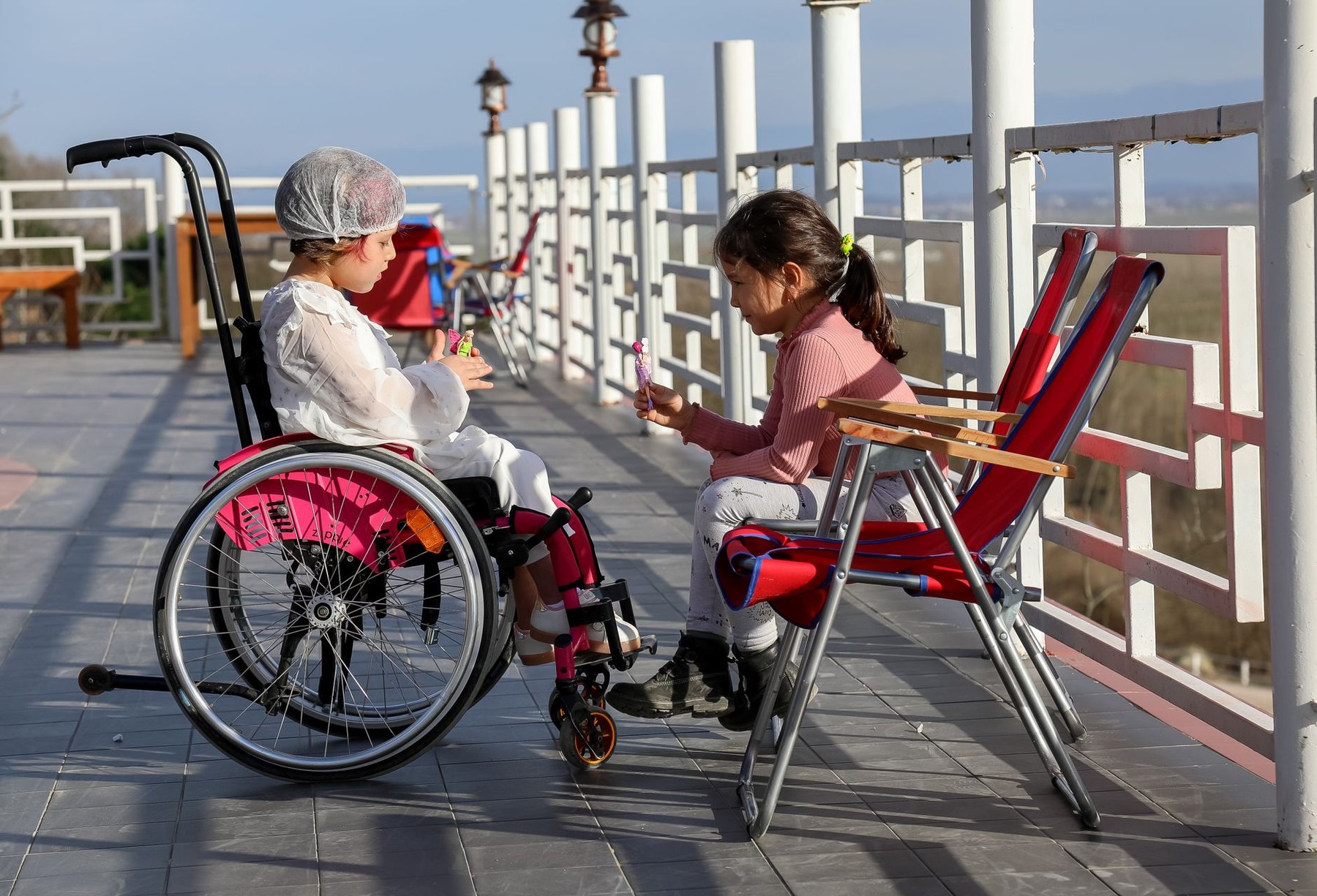
Caring for siblings of children with complex needs comes down to three things. Give them honest information in words that suit their age. Protect time that belongs only to them. Bring in outside support so you have the capacity to do both. Siblings don’t need perfect parents. They need parents with something left in the tank.
We write this as an organisation founded by parents who cared for their own child with Sanfilippo Syndrome. We know what a day looks like when one person’s needs never let up and everyone else’s get pushed to “later”. This article is for parents and guardians in Cairns, Townsville, Brisbane and across Far North Queensland who are carrying that load and wondering, usually late at night, how their other children are really going.
What siblings of children with complex needs actually experience
Start with scale. In 2022, 697,100 Australian families had at least one person aged 0-24 with disability (ABS, 2025). Most of those households include a brother or sister whose childhood is shaped by a disability that isn’t theirs. Nobody counts them. The national disability survey doesn’t identify siblings as a group, so there is no reliable figure for how many there are.
The research gives a mixed picture, and parents deserve the honest version. A meta-analysis of 28 studies found that siblings of children with chronic conditions, disability included, had higher depression scores than comparison groups, while their anxiety scores were not significantly different (Martinez et al., 2021). Treat that as something to keep an eye on. It doesn’t predict what will happen to your child. Plenty of siblings grow up with unusual empathy and patience, and a practical maturity their friends lack. Both things can be true of the same kid on the same day.
The feelings siblings describe tend to come in tangles. A girl can be proud of her brother’s small wins and still resent that every family outing is planned around his needs. A boy can love his sister, feel embarrassed by her in public, and then feel guilty about being embarrassed. Worry about the future can start very young, especially when a child overhears adult conversations about hospital admissions, funding reviews or “what happens when we’re gone”. None of this means something has gone wrong. This is what loving someone with complex needs feels like from the inside.
The pressure spreads through the whole household. Among primary carers of young people with disability, 15.4% said their relationships with other people in the household were strained, and 22.2% said they and their partner lacked time alone together (ABS, 2025). Siblings pick up on that strain even when nobody talks about it.
Then there’s the caring itself. Siblings fetch supplies, stay close while a parent rings for help, explain things to visitors, and settle a distressed brother so Mum can finish cooking dinner. Some of this is ordinary family life. Some of it slides into responsibility a nine-year-old shouldn’t hold. Young carers need an adult to decide where that line sits, on purpose, before anyone stumbles across it.
The “needless child” and why it isn’t a parenting failure
The most useful Australian research on this in years came out in June 2026. A Macquarie University team interviewed adult siblings aged 24-39. Many said they had learned to act as if they had no needs at all, to protect the family’s balance and their bond with their parents. The authors are careful about the label. These siblings became “needless” “not because they need less, but because they learned to present as if they had no needs” (Children Australia, 2026).
If you have a child who never complains, that finding is about them. The easy, self-sufficient sibling, the one who brings home good marks and never asks for anything, is the child most likely to be overlooked. UK researchers call them “glass children”: siblings whose needs people look straight through. Practitioners who run Sibshops sibling groups describe a related pattern, where siblings push themselves to be perfect, as though doing well could make up for everything else the family is going through.
The Macquarie team did not blame parents. They linked the pattern to how stretched parents were by the system around them. One participant said his parents didn’t really have a choice, because there was no real support for them in the world they were living in. The study also found that siblings kept more secure bonds with their parents when outside supports took some of the load. One woman whose sister went to disability programs and camps said she felt looked after, because those breaks were when her parents could spend time with her.
Your other children don’t need a better speech from you. They need an afternoon when you’re not on duty.
This is the point families most need to hear, and our service is built around it. Guilt does nothing for your other children. Having time and energy to give them does.
Practical ways to make room for your other children
Most of what works is unglamorous and repeatable. The table shows what tends to matter at each stage. The paragraphs after it cover the habits that apply at every age.
| Sibling’s age | What they’re often dealing with | What tends to help |
|---|---|---|
| 4-7 | Confusion about why the rules differ, worry that they might “catch” the disability, jealousy over attention | Simple, concrete explanations, reassurance that it isn’t catching and isn’t their fault, short one-on-one time they can count on |
| 8-12 | Questions about fairness, embarrassment in front of friends, small caring jobs creeping in | Honest answers to direct questions, a say in which jobs they take on, contact with other siblings in the same situation |
| Teenagers | Divided loyalties, hidden worry about the future, pressure to be the “easy” one | Private conversations away from the rest of the family, protecting their plans and milestones, permission to have a life outside the house |
| Adults | Questions about future caring roles, ageing parents, guilt about living far away | Early, open family conversations about long-term plans, clear agreement on what is expected of them and what isn’t |
Start with information. Children fill silence with their own explanations, and those are usually worse than the truth. Name the condition. Explain what it means for daily life in words that fit their age, and update that explanation as they grow. A young child may only need to know that their brother’s feeding tube is part of how he gets his meals. A teenager may want to understand where the condition is heading. If you’re not sure how to explain a diagnosis, your child’s doctor or allied health team can help you find the words.
One-on-one time counts for more than how long it lasts. Twenty minutes a week that reliably belongs to them is better than an ambitious day out that keeps getting cancelled. Put it in the calendar like a specialist appointment and protect it the same way.
Turn up for their milestones. Practitioner guidance from the Sibshops tradition notes that some siblings’ graduations went unattended because their parents couldn’t leave home (Meyer & Vadasy, 2017). Book support cover for the school concert, the grand final and the awards night well ahead. Those are the days siblings remember.
Let them be ordinary siblings. Brothers and sisters argue. If every disagreement with a sibling who has a disability is treated as unacceptable, the other child learns that their frustration is shameful. Normal conflict, within safe limits, is healthy.
Safety comes first, with no exceptions. Where a family member has behaviours of concern, siblings need a safe space, a plan they understand, and adults who take their fear seriously. A behaviour support practitioner can help a family set this up. Siblings should never have to manage it alone.
Keep an eye on how much caring they do. Here’s a simple test: would you be comfortable if their teacher knew they were doing this job? Helping out is fine. Being the backup carer at thirteen is not.
Help them find their people. Siblings Australia describes itself as the only national organisation focused specifically on siblings. It runs SibWorks, a peer support program for 8-12-year-olds led by trained facilitators, as well as online learning for parents and resources for adult siblings (Siblings Australia). The Australian Government’s Carer Gateway is another place to start for carer support. Local programs in Cairns and Townsville come and go, so ask your support coordinator, school counsellor or GP what’s running near you right now.
Know when to get professional help. Watch for a sibling who withdraws from friends or family, whose school results drop, whose sleep or appetite changes, or who becomes perfectionistic or blames themselves for things outside their control. If these signs last more than a couple of weeks, start with your GP, who can arrange a GP Mental Health Treatment Plan for subsidised sessions with a psychologist. The school counsellor is another good first step, and Kids Helpline (1800 55 1800) is free and open 24 hours a day for children and young people who’d rather talk to someone outside the family.
When the child with complex needs becomes an adult
Almost every guide on this topic stops at childhood. Our work starts much later, with adults who need support for 12-24 hours a day. The sibling story doesn’t end when everyone grows up. It changes shape.
Around one-third of Australian adults with intellectual disability are estimated to live in the family home, usually with their parents (Walker et al., 2025). Many of those households have no firm plan for what comes next. Parents get older and their own health changes. Meanwhile the siblings who moved out to build careers and families quietly start working out who will step in.
Siblings Australia has argued since 2020 that the NDIS should recognise the sibling relationship as usually the longest in a person’s life. It also points out that siblings commonly take on care, advocacy, service coordination and safeguarding roles as parents age or die (Siblings Australia). An adult sister quoted in the Sibshops literature put it plainly: “We will become caregivers for our siblings when our parents no longer can. Anyone interested in the welfare of people with disabilities ought to be interested in us.” (Meyer & Vadasy, 2017)
The Walker study paints a more hopeful picture of that handover. Once their relative moved into supported living, family members (siblings included) moved from hands-on care to what the researchers called “caring from a distance”. A 64-year-old sister said her brother’s social life opened up after he moved into Specialist Disability Accommodation, which she couldn’t have managed while he lived at home with her. A brother in the same study called his brother’s move a risk, but one he felt was worth taking because of the benefits he could see in his brother’s life (Walker et al., 2025).
Families who start future planning early can usually make decisions more calmly than those pushed into them by a crisis. We’d put these points on the table:
- What does your adult son or daughter want, and how do they tell you?
- Who can legally make decisions if parents no longer can? Guardianship and decision-making arrangements in Queensland are a legal matter. Get advice from the Office of the Public Guardian, QCAT or an independent advocate, not from a support provider.
- What role, if any, does each sibling want? Ask brothers as well as sisters. Practitioners warn against assuming daughters will take on the caring.
- Which supports could move from family to paid staff now, while parents are still around to guide the handover?
Supported Independent Living doesn’t take family out of a person’s life. Done well, it lets the family stop working shifts and go back to being a brother, a sister, a mum or a dad.
Where outside support fits, and where the NDIS stands
Be clear about funding. Right now there is no dedicated NDIS funding stream for siblings. Siblings Australia and others are pushing for sibling supports to be included in foundational supports and the federal Thriving Kids initiative. The Macquarie authors argue that funding sibling peer groups, or including sibling wellbeing in family support packages, “could buffer emotional strain and improve outcomes” (Children Australia, 2026). That is a recommendation from researchers and advocates. It is not current policy.
What the NDIS can fund is support for the participant, such as personal care, community participation and Supported Independent Living. What gets funded depends on the participant’s plan and the NDIA’s decisions. Every hour a trained support worker covers is an hour a parent can give to someone else. That is how siblings benefit indirectly, and it’s a legitimate benefit. When your family’s circumstances change, tell your support coordinator or plan manager how the informal supports in the house have shifted before the next plan review. That might be a parent’s health declining, a sibling finishing school or leaving home, or a carer who is running out of energy. Funding decisions belong to the NDIA. If you disagree with one, an independent advocate can explain your options.
Regional families face extra hurdles. Research reviewed in the Macquarie paper notes that rural and regional families deal with more service shortages and more isolation, and families in Far North Queensland know that first-hand. That makes the quality of the support you do find even more important.
For a family with other children, good outside support looks practical. The same familiar workers turn up week after week and know the participant well enough that parents can genuinely relax. Staff are trained in that person’s specific supports, so a handover doesn’t turn into a long briefing at the front door. Rostering is reliable, so the school concert booking holds.
At Advanced Disability Management, registered nurse oversight and client-specific training workshops sit behind high-intensity supports like PEG feeding, seizure monitoring and wound management. Our care team pairs that clinical structure with consistency, patience and a genuine commitment to getting to know each person they support. In our experience, this kind of steady support can give parents room to turn back towards their other children, and it may help siblings feel free to be kids again.
If you’d like to talk through what support could look like for your family, call us on 0425 168 053, email [email protected] or use the contact page on our website. We’re happy just to listen, whether you’re ready to make changes or still working out what you need.
How do I know if my child’s sibling needs professional help rather than just more time with me?
Watch for changes that last more than a few weeks, such as withdrawing from friends, trouble sleeping, slipping at school, or a child who seems constantly on edge or unusually flat. If you notice a pattern like this, book an appointment with your GP or speak with the school counsellor. They can assess what is going on and refer your child to a psychologist or counsellor if that would help.
Is it okay for an adult sibling to say they don’t want to become a future carer?
Yes. Siblings can love their brother or sister and still decide not to take on hands-on care. Saying so early gives the family time to plan other arrangements, such as paid supports or supported living, while parents are still around to help. A sibling can still play a part as an advocate, regular visitor or emergency contact, without being the primary carer.
How can grandparents and extended family support siblings?
Extended family can make a big difference by giving siblings their own attention. That might be a standing weekend outing, school pickups, or turning up to sport and performances when parents can’t. Ask relatives to focus on the sibling for its own sake, rather than only stepping in to help with the person with disability. Being chosen to spend time with someone is what helps a child feel valued.
Can siblings take part in NDIS planning meetings?
An adult participant can choose who joins their planning conversations, and that can include a brother or sister if the participant wants them there. Where someone else has formal decision-making authority, that person should be involved too. Bringing an adult sibling along can help with continuity as parents get older. Check with the participant first and respect their wishes about who attends.