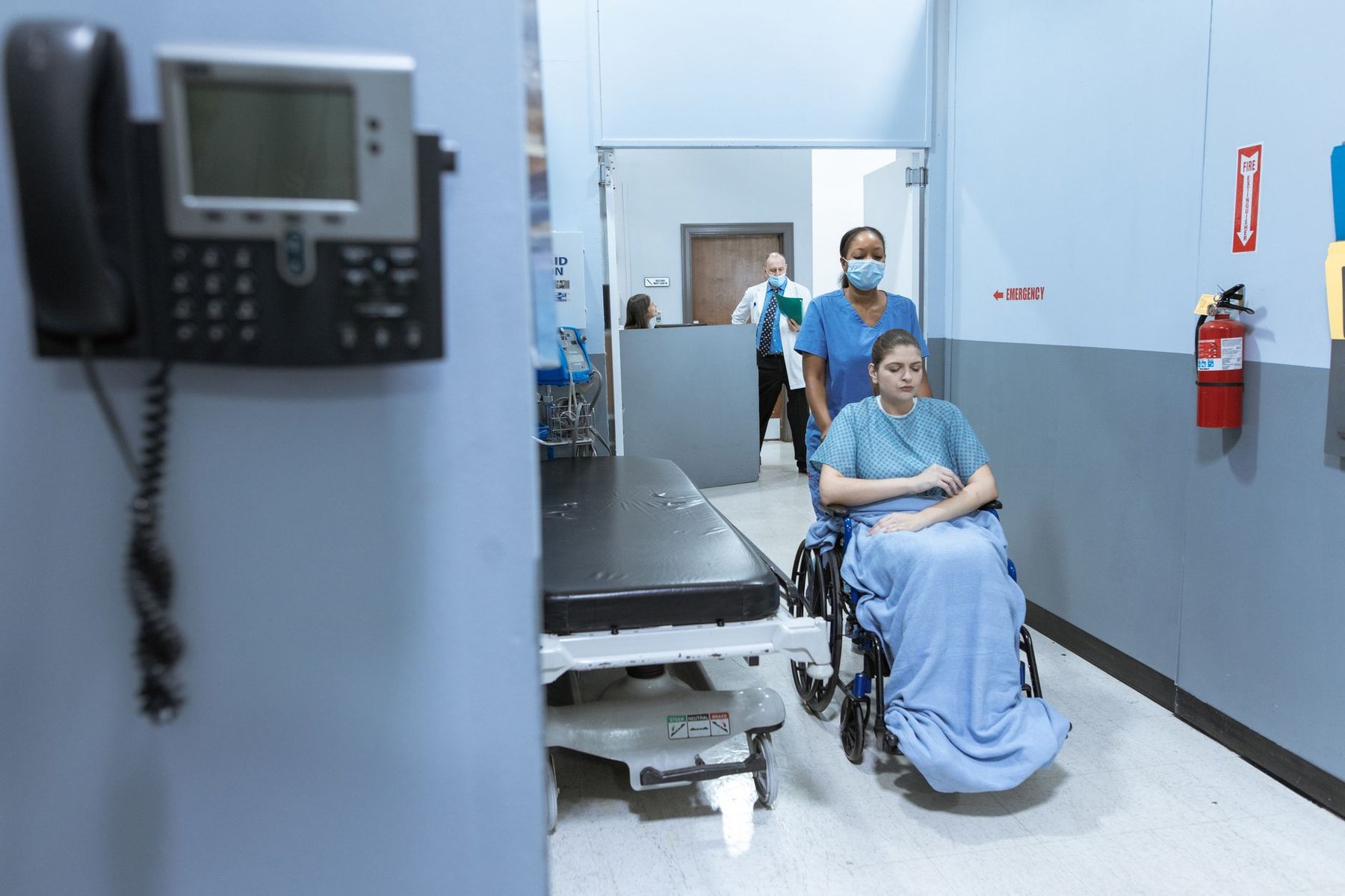
The right hospital discharge meeting questions cover five things: what daily life looks like from here, what has changed with medication, what counts as a genuine warning sign, when follow-up appointments happen, and who to call if something goes wrong. For NDIS participants and their families across Cairns, Townsville and Brisbane, a sixth question matters just as much: whether the supports being promised on paper are actually funded, staffed and ready to start on the day someone walks out the hospital door.
Why the Discharge Meeting Deserves to Be Taken Seriously
A discharge meeting is not a courtesy chat on the way out. The evidence-based framework most hospitals draw on, the IDEAL Discharge Planning model, treats it as a structured event: a scheduled conversation between the patient, the family they choose to include, and identified hospital staff, built around five fixed topics (AHRQ, IDEAL Discharge Planning Checklist). That structure exists because the alternative is expensive in every sense. Nearly 20% of patients experience an adverse event within 30 days of leaving hospital, and roughly three-quarters of those events could have been prevented with better preparation and clearer communication (AHRQ, citing Forster et al., 2003).
Most of that harm traces back to the same handful of gaps: a medication that got missed, a warning sign nobody explained clearly, a follow-up appointment that fell through the cracks. None of it is exotic. All of it is preventable with the right questions asked in the room, before anyone signs anything.
The 12 Hospital Discharge Meeting Questions to Bring With You
Print this, or screenshot it. Walk in with someone whose only job is to ask these and write down the answers.
| # | Category | Question to ask |
|---|---|---|
| 1 | Condition and recovery | What has changed since admission, and what should we realistically expect over the next few weeks? |
| 2 | Medication | Which medications are new, changed, or stopped, and what side effects should we watch for? |
| 3 | Warning signs | What specific signs mean we call the GP, call the support coordinator, or go straight to emergency? |
| 4 | Follow-up care | Which follow-up appointments are already booked, and who is responsible for booking the rest? |
| 5 | Daily living support | What level of personal care, supervision, or therapy will be needed at home, and who is providing it? |
| 6 | Equipment and home modifications | What equipment or home modifications need to be in place before discharge, and are they actually ready? |
| 7 | NDIS plan status | Does the current NDIS plan fund what’s needed now, or does an interim plan need to be requested? |
| 8 | Funding gaps | Which supports sit under NDIS funding, which sit under the health system, and where is the gap? |
| 9 | Care team continuity | Which support workers, nurses, or allied health professionals will be involved, and how is client-specific training handled? |
| 10 | Documentation | What written discharge summary, care plan, and medication list will we leave with today? |
| 11 | Point of contact | Who is our single point of contact if something goes wrong in the first 72 hours at home? |
| 12 | Timing and delays | If supports aren’t ready on the planned date, does discharge get delayed, or does an interim arrangement start? |
Questions 7, 8 and 12 rarely appear in generic discharge advice, because most of it is written for a US or general aged-care audience. For NDIS participants they are the ones most likely to determine whether discharge day actually goes ahead on schedule.
Why NDIS Discharge Planning Runs on a Different Clock
Hospital discharge for NDIS participants follows a separate, formal pathway that most families only discover once they’re already inside it. The NDIA’s Hospital Discharge team aims to make contact with the participant or their representative within four days of being notified of the admission, and hospital staff are expected to supply health information and evidence before planning can properly start (NDIA, NDIS hospital discharge guidance). If a full plan review can’t be completed in time, the NDIA can issue an interim plan, a temporary funding arrangement designed to support a safe and timely discharge rather than leave someone waiting in a hospital bed for paperwork.
When coordination between the hospital and NDIS breaks down, there’s a specific escalation point: the Health Liaison Officer, whose role is to resolve exactly this kind of hospital-to-NDIS friction. Ask early in the process whether an HLO has been assigned to the case. It’s a fair question, and hospital social workers are used to hearing it.
This isn’t a minor administrative detail either. The NDIS Quality and Safeguards Commission maintains a Practice Alert on transitions of care between home and hospital, which signals that hospital-to-home coordination for NDIS participants remains an active compliance and quality focus for the regulator. If a hospital or provider seems unfamiliar with the pathway, that’s worth raising directly.
When Discharge Takes Longer Than Anyone Wants
Standard discharge planning assumes a linear recovery: fix the acute problem, arrange some support, go home. Complex and degenerative disability doesn’t follow that shape. Guidance from NDIA and disability sector bodies is explicit that people with more complex needs may require more than one NDIS planning cycle and more than 30 days to have appropriate supports properly established, particularly where behaviour support assessments, specialist equipment, or home modifications are involved (NDIA guidance, via Summer Foundation and National Disability Services resources).
That timeline is frustrating to hear in a hospital corridor when everyone just wants to go home. It’s also honest, and honesty here matters more than false reassurance.
A discharge meeting where nobody takes notes is a meeting that didn’t happen, no matter how thorough the conversation felt at the time.
We built Advanced Disability Management out of exactly this kind of discharge experience, having sat on the family side of the table navigating complex care decisions for our own child with Sanfilippo Syndrome. Discharge planning for a degenerative or high-support condition is a different exercise from discharge after a fracture or an infection. It needs registered nurse oversight, staff trained on that specific person’s needs rather than generic competencies, and allied health input from occupational therapy, physiotherapy, speech therapy or dietetics folded into the plan from day one rather than bolted on afterwards. If a discharge meeting glosses over any of that, push back and ask for it in writing.
Queensland’s Stranded Patients Problem, and What It Means for Your Family
If a hospital tells your family that discharge is delayed because “the supports aren’t ready,” that’s not a brush-off. It’s a named, tracked, systemic issue in Queensland’s health system, officially referred to as stranded patients: people who are clinically fit to leave hospital but remain there because supports on the outside aren’t in place. Queensland has reported a significant and ongoing number of patients experiencing delayed discharge, alongside a further group in interim care. Younger long-stay patients are typically waiting on NDIS supports to be arranged, while older patients are more often waiting on residential aged care placement.
This isn’t a new problem. Queensland’s Public Advocate has previously recorded significant numbers of long-stay patients, including younger patients, and pointed to NDIS plan approval delays and accommodation shortages as the main barriers for that younger group. Knowing this context changes how you use the discharge meeting. Instead of accepting a vague “we’re waiting on approvals,” ask precisely which approval, from whom, and what the interim arrangement looks like while everyone waits.
Who Should Be in the Room
Every strong discharge process, clinical or NDIS-specific, converges on the same practical point: one person needs to be designated as the primary contact for the meeting, responsible for being present, asking the clarifying questions, and writing everything down. It sounds obvious. In practice, families walk into these meetings distracted, exhausted, and outnumbered by clinical staff who move through five topics in fifteen minutes. AHRQ’s own clinical guidance tells hospital staff to treat patients and family as full partners in the process and to include them in every team meeting about discharge, not just a final sign-off (AHRQ, IDEAL Discharge Planning Overview). Families are entitled to ask for that in practice, not just in principle.
If a support coordinator, plan manager, or provider like ADM is already involved, ask for them to be included in the meeting, even by phone. They can translate NDIS terminology on the spot and flag funding gaps before they become a crisis three weeks after discharge, when everyone has gone home and stopped paying close attention.
After the Meeting: Turning Answers Into a Plan
Walking out with answers is only half the job. Walking out with paper is the other half. The minimum set of documents a family should leave with is consistent across health and NDIS guidance: a discharge summary, a care or discharge plan, a medication summary, written confirmation of equipment or device arrangements, and details of every follow-up appointment and referral (NDIS Commission and WA Health guidance). If any of these five aren’t handed over on the day, ask when they’ll arrive and who is sending them. A verbal promise is not a plan.
Once home, the real test of a discharge meeting isn’t whether it felt reassuring at the time. It’s whether the medication list matches what’s actually in the box, whether the follow-up appointment gets a reminder call, and whether the person who said they’d coordinate support actually does. Discharge, done properly, is a process that runs for weeks after the hospital bed is empty, not a single afternoon of signatures.
If you’re preparing for a discharge meeting involving high-intensity care, complex medical needs, or an NDIS plan that doesn’t yet reflect what’s needed at home, it helps to talk it through with people who have done this before, both professionally and as a family. Advanced Disability Management works alongside families across Cairns, Townsville and Brisbane on exactly this kind of transition, and a conversation before the meeting is often more useful than one after it. Call us on 0425 168 053, email [email protected], or reach out through our contact page whenever you’re ready to talk it through.
Who is allowed to attend the hospital discharge meeting with a participant?
There’s no strict limit. Hospitals generally welcome the patient’s chosen family members, a support coordinator, plan manager, or disability provider representative, and an advocate if one is involved. If you want a specific person included, especially by phone, ask the ward or discharge planner in advance so they can schedule accordingly.
What happens if the hospital wants to discharge before NDIS supports are arranged?
Raise this directly with the hospital’s discharge planner and ask whether an interim NDIS plan can be requested to fund immediate supports while a full plan is finalised. If coordination stalls, ask whether a Health Liaison Officer has been assigned, as resolving hospital-to-NDIS delays is part of their specific role.
Can a family refuse a hospital discharge if they feel it’s unsafe?
Families can raise safety concerns formally with the treating team and ask for the discharge to be reviewed, but the final clinical decision sits with the hospital. If concerns aren’t resolved, seek advice from a patient advocate, the NDIS Commission, or the hospital’s patient liaison service rather than relying on an informal objection alone.
What if we forgot to ask something and the patient has already gone home?
Contact the discharging ward or the hospital’s health information service and request a copy of the discharge summary, which should already include medication and follow-up details. Most hospitals can also arrange a follow-up call with the treating team or social worker if questions come up after the person has left.
Does a support coordinator need to be at every discharge meeting?
It isn’t compulsory, but it’s worth requesting if the participant has an active NDIS plan, since a support coordinator can clarify funding categories and flag gaps in real time. If they can’t attend in person, ask whether they can join by phone for the parts of the meeting covering funding and ongoing supports.