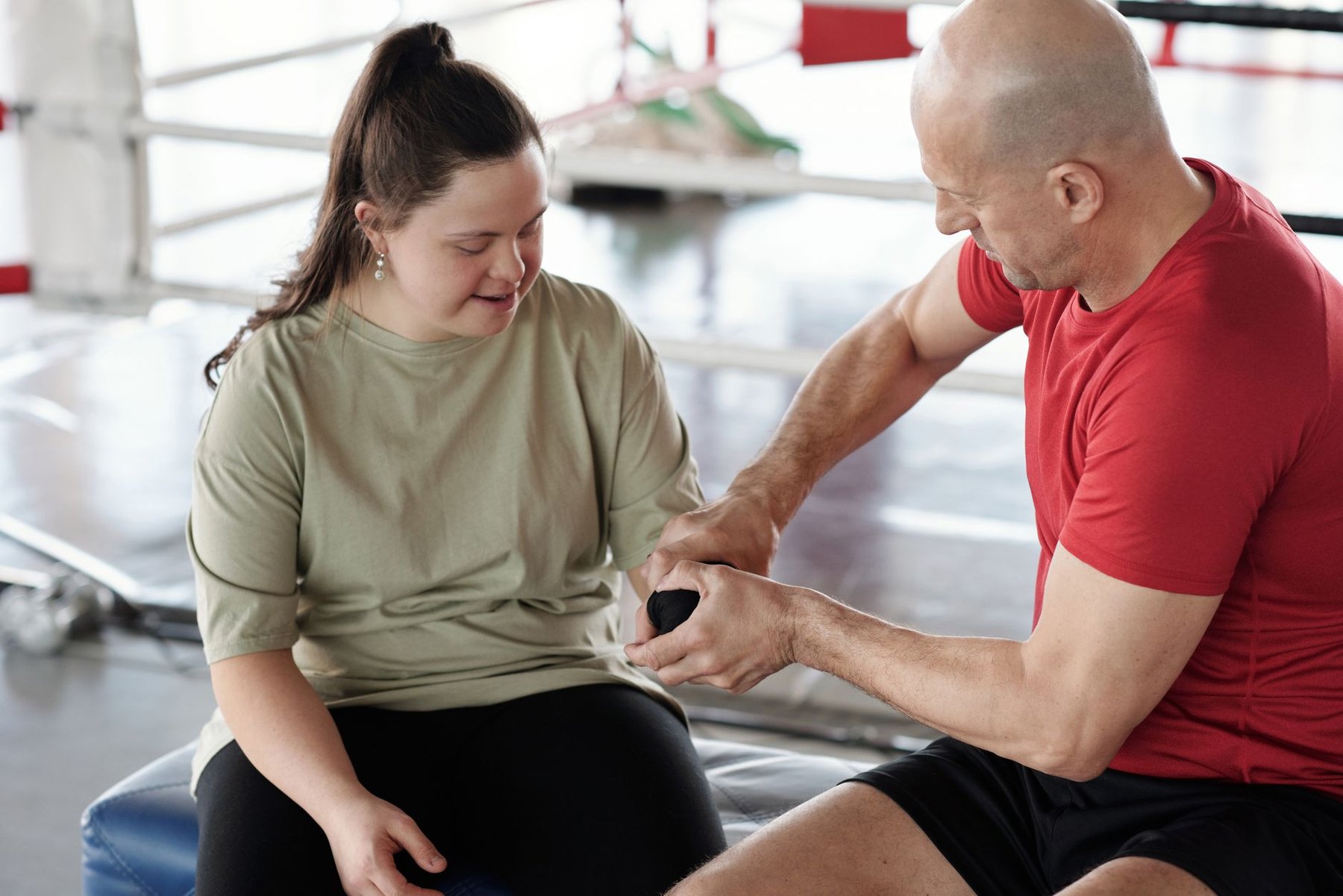
Relationship-based disability care means the same small team of support workers stays with a person over months and years, learning how they communicate, what settles them and what they enjoy. For adults with complex needs, that familiarity is what safe, respectful support is built on. Workers who know the person pick up changes sooner, read non-verbal cues and respect their choices.
We came to this view the hard way. Advanced Disability Management was founded by parents who cared for their own child with Sanfilippo Syndrome, and they learned early that a new face at the door every week is exhausting for everyone. It means re-explaining the same routines and the same signs of distress, then hoping the next person gets it right. That experience shapes how we run Supported Independent Living and high-intensity support across Cairns, Townsville and Brisbane today, and it’s why this article argues for continuity as the first thing families should ask about.
What relationship-based disability care actually looks like
At its simplest, relationship-based care is a way of delivering support, not a type of support. The same activities happen: personal care, meals, community outings, medication support, transport. The difference is who does them and how well they know the person.
In practice, it has a few visible features. A participant has a core team of workers rather than an open roster. New workers are introduced gradually, alongside someone who already knows the person. Knowledge about the person (how they show pain, what a good morning looks like, which foods they refuse and why) is written down and kept current, so it doesn’t walk out the door when a worker leaves. And the family is treated as a source of expertise, while the adult at the centre stays the decision-maker in their own life.
Don’t confuse it with the Improved Relationships budget
Search for “relationships” and “NDIS” and you’ll mostly find explainers on Improved Relationships, a Capacity Building funding category. That budget is for specific supports, often to do with behaviour support and building social skills, and whether it appears in a plan is a decision for the NDIA. Relationship-based care is different. It describes how a provider staffs and runs support across any part of a plan. A participant can receive relationship-based care with or without an Improved Relationships budget. If you’re unsure what your plan’s categories cover, your support coordinator or plan manager is the right person to ask.
Why familiarity matters most for people who don’t use speech
For an adult who communicates through movement, sound, facial expression or behaviour (forms of non-verbal communication), a stranger is close to useless as a communication partner. Even a skilled and kind stranger. The person has to start again with every new worker, and many people with complex disabilities don’t have the energy or tools to do that over and over.
The research backs this up. A systematic review of everyday decision-making for adults with intellectual disability included 81 papers. Knowing the person well came up as a facilitator of good decision support more often than any other factor, in 6 papers. Lack of familiarity with the person’s needs appeared as a barrier in 4, and the most common barrier of all, in 8 papers, was underestimating and not listening to the person (Casey et al., 2023).
That same review describes how familiar workers and family members read body cues and behaviour patterns in adults with severe intellectual disability. When someone kept returning to a certain activity, food or person, that was treated as a preference and written into their care plan. It also highlights La Trobe University’s Supported Decision-Making Framework, developed by Christine Bigby and colleagues, which makes “knowing the person” the first of its seven steps. Active Support, the best-known evidence-based model in this space, rests on staff using an enabling relationship to support engagement in meaningful activities and social connection, and studies linked it to better staff support and more engagement (Casey et al., 2023).
Put plainly: you can’t support someone’s choices if you can’t tell what they’re choosing.
For the people we support, this goes beyond preferences. Many live with high medical needs: PEG feeding, seizure activity, wound care. A worker who has spent months with someone knows what their usual looks like. That matters when the job is noticing that something has changed and passing it on promptly to the registered nurse overseeing their care, or to the person’s own doctor. Clinical decisions belong with that health team. Recognising early that something is off belongs with the people who know the person best.
The person, the family and the worker
Relationship-based care involves three relationships, and they don’t always pull in the same direction.
Families bring years, often decades, of knowledge. Nobody knows a son’s particular laugh or a wife’s signs of pain better than the people who have lived with them. A good provider takes that knowledge seriously from the first conversation and builds it into everything: the support plan, the induction for new workers, the handover notes.
The research also names a tension we think is worth saying out loud. Families and support workers both agreed that knowing the person well was vital. But support workers tended to stay neutral when a decision came up, while family carers more often felt their knowledge meant they could decide what was best. Neither position is wrong in itself. The aim of supported decision-making is to keep the adult at the centre: drawing on everyone’s knowledge to work out what they want, then helping them get it.
A care plan tells a new worker what to do. Only time with the person tells them who they’re doing it for.
We see our role as sitting alongside families, not replacing them. A worker who has been with someone for a year can offer families something valuable: a second, independent read on how the person is going, what they’ve enjoyed lately, what seems to bother them. That’s a partnership. It can also give families back time that’s genuinely theirs, because handing over care feels very different when you know exactly who is walking through the door.
Strong, varied relationships also do something less obvious. In recent Australian research, interviewees described social networks that reach beyond service providers as a protection against isolation, neglect and abuse. The same study found worker retention was higher when the worker and the person agreed conditions between them (Laragy & McVilly, 2026). A person with several trusted people in their life (family, friends, familiar workers, community connections) has more people noticing how they’re going. We’d rather a participant had a wide circle than depended on any single relationship, including one with us.
The honest problem: workers leave
Any provider that promises you the same worker forever is overselling. Workforce turnover in disability support is high. Each year, 17%-25% of NDIS support workers leave their job, and the NDIS Review panel heard from many workers who feel burnt out and are unsure they want to stay in the sector (NDIS Review).
The frustration with rotating rosters goes both ways. In interviews that included NDIS workers and families, people disliked strangers who didn’t understand their needs coming into their home, whether for personal care or housework. Support workers, for their part, disliked being rostered to people they didn’t know. One self-managing interviewee put it simply: “You don’t know who’s coming into your house. You don’t know their skill sets.” The study was focused on aged care, but its conclusion that workforce relationships are central to satisfaction and quality of care applies just as well to disability support (Laragy & McVilly, 2026).
So the real question for families is what a provider does to protect the relationship when someone moves on. Our answer has several parts.
- Core team: When a participant knows three or four workers well rather than relying on one person, a resignation or a fortnight of annual leave is a change to manage rather than a crisis.
- Client-specific training: We run regular client-specific workshops, so workers learn the person in front of them, not just general procedures.
- Registered nurse oversight: A registered nurse oversees high-intensity supports, which gives continuity of clinical knowledge even when the roster shifts.
- Thorough documentation: The detail families carry in their heads needs to live somewhere a new worker can read it before their first shift.
Then there’s the part that’s harder to put in a policy. We recruit for patience, warmth and a commitment to treating people as individuals, not tasks on a list. In our experience, workers who see care this way tend to stay longer and form real bonds.
Distance makes continuity harder in the north
Regional Queensland adds its own pressure. In Cairns and across Far North Queensland, the pool of experienced high-intensity workers is smaller than in a capital city, and travel times between suburbs and outlying towns make it harder to cover a gap at short notice. Townsville faces a version of the same thing. This is exactly why we think regional providers have to plan for continuity on purpose: building local core teams around each participant, training backup workers before they’re needed, and not stretching one worker across too many people spread over too wide an area.
What to ask a provider before you commit
Families tell us they don’t know which questions separate a provider with real continuity from one that just says the word. These are the ones we’d ask if we were in your position, along with what a solid answer sounds like.
| Question to ask | What a solid answer sounds like |
|---|---|
| Who will actually come to the house? | Named workers who form a small core team, introduced before support starts |
| What happens when a regular worker is sick or on leave? | A trained backup who already knows the person, not whoever is free |
| How will new workers learn non-verbal cues? | Shadow shifts with an experienced worker, plus written communication guides |
| How are high-intensity supports overseen? | Registered nurse oversight and training specific to the person’s needs |
| How do you include our family’s knowledge? | Family input built into the support plan and new-worker induction |
| How does the person themselves have a say? | Supported decision-making in everyday choices, including who supports them |
| What happens if a worker isn’t the right fit? | A straightforward process to raise it and change, without friction |
Listen for specifics. A provider that answers “we have a large pool of workers” to the first question is describing a roster, not a relationship. Pay attention too to whether they ask about the person: their routines, their history, what they love. Providers who care about continuity want to know who they’re supporting before they talk about hours.
Where relationship-based care fits in NDIS funding and choice
Relationship-based care isn’t a separate line item, so there’s no budget to request for it. It sits inside the supports already in a participant’s plan, whether that’s Supported Independent Living, assistance with daily personal activities, community participation or transport. What changes is how a provider delivers those supports.
Choice and control is the NDIS principle that matters here. Participants and their nominees can choose their providers and can change them. If continuity matters to you, put it at the centre of how you pick a provider, and raise it with your support coordinator so it’s reflected in the service agreement and support plan. Funding amounts, plan categories and reviews are decisions for the NDIA, and a support coordinator, plan manager or independent advocate is the right place for advice on those.
The policy direction points the same way. The NDIS Review’s final report, released in December 2023, asked the NDIA to roll out navigation support “prioritising continuity of support for participants and their families,” called for pricing that promotes quality supports and continuity of supply, and recommended a workforce responsive to participant needs (NDIS Review). Rules and pricing arrangements change, so check current requirements with the NDIA and the NDIS Quality and Safeguards Commission rather than relying on any single article, this one included.
Our position is simple. For adults who need 12 to 24 hours of support a day, especially those with complex communication or high medical needs, continuity is the core of good care rather than an extra. Familiar workers can make daily life calmer, safer and more like the person’s own, and they can give families the confidence to step back and rest.
If you’d like to talk through what relationship-based support could look like for your family member, we’re happy to have that conversation with no obligation. Call us on 0425 168 053, email [email protected], or get in touch through our contact page, and we’ll start by getting to know the person.
Can my family member request a specific support worker?
Yes, participants and their nominees can ask for particular workers, and a provider that values continuity should welcome the request. Availability depends on rosters and the worker’s own commitments, so it helps to name two or three preferred workers rather than one. Put preferences in writing and ask the provider to record them in the service agreement or support plan so they carry through when rosters change.
Does relationship-based care cost more under the NDIS?
It is not a separate service with its own price. Supports are charged within the NDIS Pricing Arrangements and Price Limits that apply to each support item, whichever way the provider staffs them. The difference lies in how the provider organises its team, not in a premium charge. Check any quote against the current pricing arrangements and talk it through with your plan manager or support coordinator.
How long does it take a new worker to get to know someone with complex needs?
There is no fixed timeline. It depends on how the person communicates, how often the worker is rostered with them and how good the handover is. Regular, frequent shifts with the same person build familiarity far faster than occasional ones. Introducing a new worker gradually, alongside someone the person already trusts, also tends to make that early period easier for everyone involved.
What should we do if a regular worker is not the right fit?
Raise it early and directly with the provider’s coordinator or manager. A good provider treats fit as a legitimate reason to make a change and will not ask the participant or family to justify it at length. If the person cannot say so in words, changes in their behaviour or mood around a worker are worth mentioning. You can also contact the NDIS Quality and Safeguards Commission if a concern is not resolved.
Is relationship-based care only relevant for people living in SIL homes?
No. The approach applies wherever support is delivered, including in a family home, during community participation or on transport. Some families start with a few regular shifts each week from a consistent worker so their family member can build trust before support increases. The principle stays the same in every setting: a small, familiar team who understands the person.