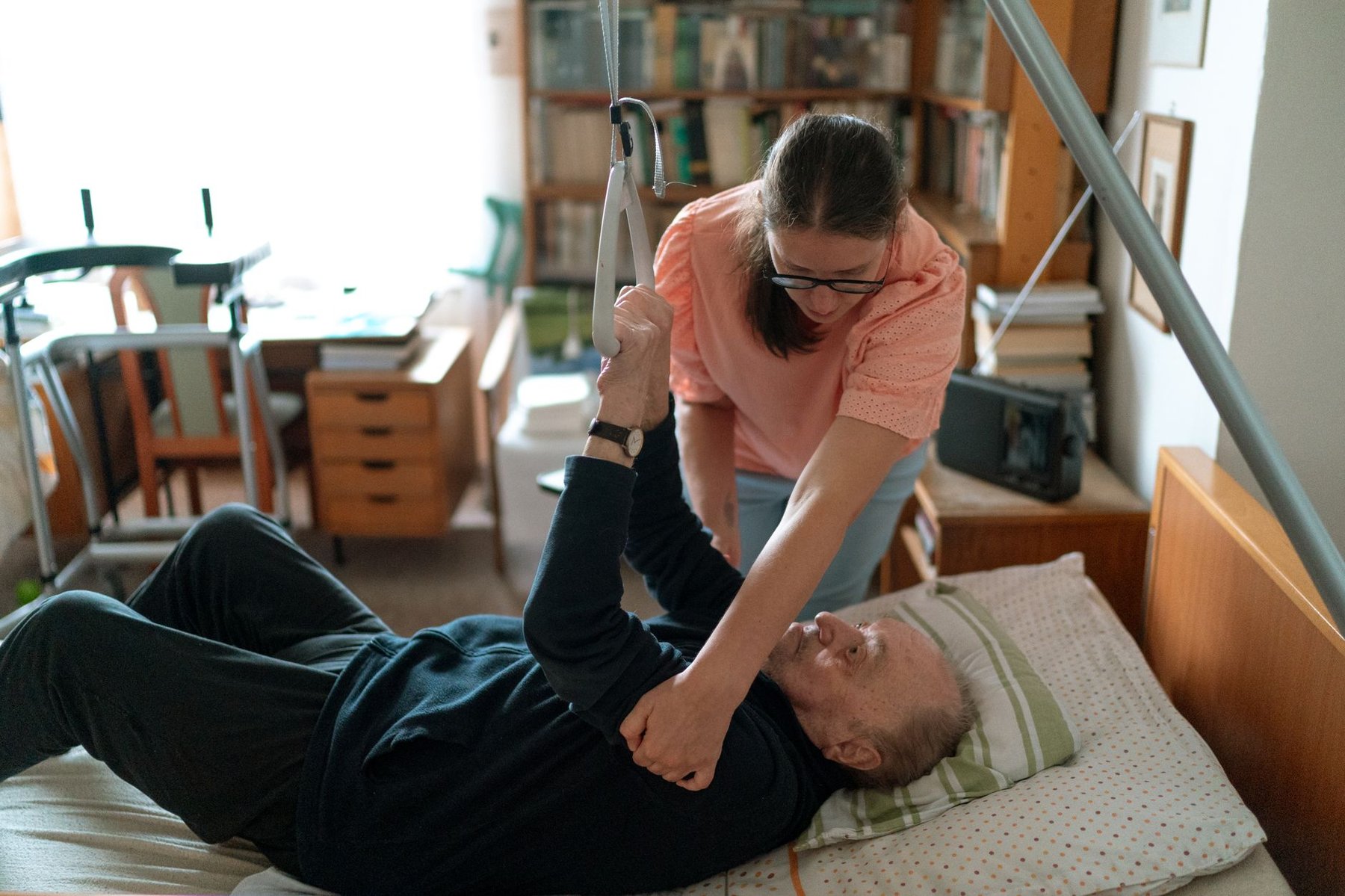
A complex care intake is how a provider learns exactly how to support an adult with high-intensity needs before the first shift starts. It moves through a first conversation, a clinical assessment, a written support plan, staff matching and person-specific training, then a planned start with early review. A well-run complex care intake process puts the participant’s voice and safety first.
We know this process from both sides of the table. Advanced Disability Management was founded by parents who spent years arranging care for their own child with Sanfilippo Syndrome. They sat through intake meetings where nobody asked the right questions, and through others where a careful provider got it right. This guide sets out what should happen, what you can prepare, and why the speed of intake matters less than getting the order right.
Why intake matters more in Queensland right now
Hospitals in Queensland are holding a lot of people who are medically ready to leave but have nowhere suitable to go. Long-stay patients waiting for discharge to aged care or an NDIS placement passed 1,400 in 2026, more than three times the 2022 figure (Queensland Health, 2026). An earlier count found 168 long-stay patients in Queensland Health facilities waiting specifically on NDIS services (Queensland Public Advocate, 2025).
Behind every one of those numbers is a person waiting for a provider able to deliver complex supports safely. In Far North Queensland, distance and a small pool of skilled providers make that harder. A family in Cairns or the Tablelands may have fewer options than a family in inner Brisbane, and that puts pressure on providers to say yes quickly.
Pressure is a poor reason to skip steps. Intake is where a provider shows whether it can actually do the work. It is also where families get their best chance to judge whether the provider understands the person, and not just the diagnosis.
The complex care intake process, stage by stage
Every provider labels its stages differently, but the order shouldn’t change. Here is how the stages fit together and where families come in.
As a rough guide, the first conversation and clinical assessment usually take a few days to a week or two. Writing the support plan, training workers and signing off their competency often takes a few weeks more. Incomplete clinical information, slow consent to share records, equipment delays and finding the right worker match are the most common reasons it takes longer.
| Stage | What the provider does | What the participant and family contribute |
|---|---|---|
| First conversation | Listens, screens for risk, confirms which high-intensity supports are needed and whether the provider is registered to deliver them | The person’s story, daily routine, what works and what doesn’t |
| Clinical assessment | Reviews health history, current supports, equipment, communication and goals, with input from treating clinicians | Discharge summaries, current protocols, consent to share information |
| Support plan | An appropriately skilled person writes a plan covering needs, preferences, strengths, goals and risks | Review of the draft, corrections, priorities in the person’s own words |
| Matching and training | Selects workers, runs participant-specific training, assesses each worker’s competency | Introductions, feedback on fit, sharing personal preferences |
| Planned start | Begins supports with clinical oversight and shadow shifts where needed | Early feedback on anything that feels off |
| Review | Checks the plan against reality and adjusts | Honest input on what is and isn’t working |
The first conversation
This conversation sets the tone for the rest of intake. A good intake coordinator spends most of it listening. They want to hear how the person communicates, what a good day looks like, what has gone wrong with past supports, and who makes which decisions.
They should also ask early which high-intensity supports are involved. The NDIS Practice Standards include a High Intensity Daily Personal Activities module covering supports such as complex bowel care, enteral (PEG) feeding, urinary catheter care, seizure management, subcutaneous injections and respiratory support. A registered provider may only deliver the high-intensity supports listed on its registration certificate (NDIS Quality and Safeguards Commission, HIDPA Supplementary Module). If a provider can’t tell you plainly which ones they’re registered for, keep asking until they can.
Clinical assessment and the support plan
The assessment is where the provider builds a detailed picture of the person’s health and daily life. Expect it to cover medical history, current clinical protocols, equipment, skin integrity and pressure care, mobility and falls, nutrition and swallowing, communication, cognition, behaviour support where relevant, and the person’s own goals. At ADM, our registered nurse oversight shapes this stage, and we work alongside the person’s existing allied health team (occupational therapists, physiotherapists, speech pathologists, dietitians and psychologists) rather than starting over.
Clinical decisions stay with the people who own them. The provider’s job is to understand and carry out the plans set by the person’s doctors and allied health practitioners, not to rewrite them.
From there, an appropriately skilled person within the provider writes the support plan before supports begin. It has to reflect the participant’s needs, preferences, strengths and goals, and be reviewed regularly (NDIS Quality and Safeguards Commission, Practice Standards). The participant must be involved in developing it. For someone who communicates without speech, that means time spent learning how they say yes, no and “not like that”, and building it into the plan.
Matching, training and competency sign-off
This is the stage most often rushed, and the one that matters most for families.
Workers delivering high-intensity supports need the skills set out in the relevant High Intensity Support Skills Descriptor, and their training has to be specific to the participant. Generic certificates aren’t enough on their own. A worker who has managed PEG feeding for someone else still needs to learn this person’s regime, equipment, positioning and warning signs.
Families often assume every high-intensity support has to be delivered by a nurse. A trained support worker who has been assessed as competent can deliver many of these supports, provided appropriate clinical oversight is in place. ADM’s model is built on exactly that: registered nurse oversight, regular client-specific training workshops, and workers who are signed off on the individual, not just the task.
Matching goes beyond skills. Our care team brings diverse cultural backgrounds, including from Vanuatu, Papua New Guinea and Fiji, and a strong commitment to person-centred care. We match on personality, language, routine and gender preference, because a technically skilled worker the person doesn’t feel comfortable with isn’t the right fit.
Planned start and early review
The first weeks should be deliberately supported. Shadow shifts, where a new worker supports alongside someone already competent, give the person time to get used to a new face and give the provider a chance to spot gaps. Early review meetings let families raise small concerns before they grow. A plan that has never been tested on a real Tuesday morning is still a draft.
When intake starts from a hospital bed
Many complex care intakes start in a hospital ward rather than at a kitchen table. That changes how intake runs.
The NDIS Commission updated its Practice Alert on transitions of care between home and hospital in January 2025. It expects planned, coordinated transitions with clear communication between the participant, family, hospital staff and provider. Before supports resume, the provider should understand any changes to medications, equipment, procedures and risks (NDIS Quality and Safeguards Commission, 2025).
In practice, this means the provider talks directly with the ward team, the discharge planner and, where possible, the treating allied health clinicians. It means confirming that equipment will be in the home and working on day one, not arriving the following week. It means workers may need to visit the ward to learn new routines before discharge. If the person already receives supports and has had a hospital admission, intake effectively happens again, because a person coming home after a hospital stay may need different support than they did before they went in.
Discharge timelines move fast once a bed is needed, and families can feel swept along. You can ask the hospital and the provider to slow down and confirm the plan before a discharge date is locked in. The person’s support coordinator can help coordinate this.
What to have ready before the first meeting
Families can make intake faster and safer by gathering documents early. Not everything here will apply, and a good provider will help you find what’s missing.
- The current NDIS plan, including how it is managed (NDIA-managed, plan-managed or self-managed)
- Contact details for the support coordinator and plan manager, if there are any
- Nominee, guardian or substitute decision-maker details, including any tribunal orders
- The most recent hospital discharge summary
- A current medication chart from the person’s doctor or pharmacist
- Existing clinical protocols, such as a PEG feeding regime, seizure management plan, bowel care plan or wound care plan
- Any positive behaviour support plan
- An equipment list, with supplier and servicing details
- Allied health reports from the past one to two years
- A one-page profile in the person’s own words, or as close as possible: likes, dislikes, routines, how they communicate, what upsets them
That last document is often the most useful thing a family brings. Clinical paperwork tells a provider what to do. The personal profile tells them how to do it in a way the person will actually accept.
It’s also worth asking early who pays for intake. Parts of it, such as the assessment, writing the support plan, participant-specific training and shadow shifts, may be billed to the person’s NDIS plan, and which budget they come from depends on the plan and how the supports are funded. A good provider will explain this in writing before any work starts, so you can check it with your plan manager or support coordinator.
Questions worth asking any provider
Intake goes both ways. You’re assessing the provider as much as they’re assessing the support. These questions tend to show quickly whether a provider has real depth:
- Which high-intensity supports are on your registration certificate?
- Who writes the support plan, and what are their qualifications?
- How do you train workers on this person specifically, and who signs off their competency?
- What clinical oversight is in place day to day, and who do workers call at 2am?
- How will you handle staff leave and turnover so the person isn’t supported by strangers?
- How often will the plan be reviewed, and how do we raise concerns between reviews?
- What would make you delay or decline starting?
The last question is the most revealing, and it deserves its own section.
Why a good provider sometimes says “not yet”
Some providers promise to start within days. For lower-intensity supports that can be reasonable. For an adult needing PEG feeding, seizure monitoring and two-person transfers, a start date that quick usually means a step has been skipped.
A careful provider should delay starting if it can’t deliver the support safely yet. That might be because the clinical information is incomplete, the right equipment isn’t in the home, or no worker has been assessed as competent on this person’s protocols. These are real reasons, and none of them should be negotiable.
The provider who tells you “not yet, and here is exactly why” is usually the one you can trust with “yes”.
We understand how hard it is to hear that when you’re exhausted and have been the only carer for months. The founders of ADM have been in that position. Even so, a start date that holds is worth more than an early one that falls apart in the first week and puts the person back in hospital. A clear explanation, a short list of what still needs to happen, and a realistic date can often ease that frustration. When a provider can’t give you those three things, treat that as useful information too.
How intake records fit the coming NDIS changes
The rules around NDIS planning are changing. New framework planning is being introduced, with plan budgets expected to be based on a structured assessment of support needs. Adult participants move across progressively until the end of 2030, and people with more complex needs are expected to receive additional or targeted assessment (Department of Health, Disability and Ageing, 2026). Separately, providers of Supported Independent Living became subject to mandatory registration from 1 July 2026 (Department of Health, Disability and Ageing, 2026).
Our view is that this makes good intake records more valuable. A diagnosis says little about daily life. A well-written support plan describes how often support is needed, how intense it is, what risks are involved and how they’re managed. That kind of record may be useful to participants, support coordinators and allied health practitioners when they prepare for future assessments. Funding decisions remain entirely with the NDIA, and nothing a provider writes can guarantee a particular plan outcome. Detailed, accurate records simply give the person’s own team better material to work with. Questions about assessments, reviews or appeals are best taken to your support coordinator, planner or an independent disability advocate.
Getting the order right
Every stage of a good intake follows the same rule: understand the person first, then the support, then the workers, then the start date. When providers reverse that order to meet a deadline, families tend to feel it within the first fortnight. When they keep to it, the person is more likely to get continuity, and families can often step back from the caring role with real confidence.
If you’d like to talk through what intake could look like for your family member, in Cairns, Townsville or Brisbane, we’re happy to have that conversation with no obligation. Call us on 0425 168 053, email [email protected], or get in touch through our contact page, and we’ll start by listening.
Can a participant change providers partway through a complex care intake?
Yes. Participants keep choice and control throughout. If intake reveals the provider is not the right fit, the participant or their decision-maker can stop and approach another provider. It helps to ask for copies of any assessments or draft plans so the next provider is not starting from nothing, and to let the support coordinator know so they can help with the handover.
Does the participant need a support coordinator before starting intake?
No. Many people contact a provider directly, and intake can begin with the participant, family or guardian. A support coordinator is helpful for complex situations, especially hospital discharges or arranging several providers, because they can connect the different parties. If coordination is not in the current plan, the person’s planner or local area coordinator can explain the options.
Is there a cost to families for the intake meetings themselves?
How intake activities are handled depends on the provider and the supports involved, so ask the provider directly before you begin. Some planning and assessment work may be claimable against the participant’s NDIS budget under current pricing arrangements, while other early conversations happen before any service agreement is signed. A clear provider will explain this upfront in writing.
What happens if the person cannot give consent themselves?
Where an adult cannot give informed consent for a particular decision, the provider works with their nominated decision-maker, such as a guardian or nominee appointed through the proper legal process. The person should still be involved as much as possible, with their preferences recorded in the plan. For questions about guardianship in Queensland, families can seek advice from the Office of the Public Guardian or an advocate.
Can intake happen if we live outside Cairns, such as on the Tablelands or further north?
Often it can. Early conversations and document gathering can happen by phone or video, with in-person visits arranged for the clinical assessment and worker introductions. Whether ongoing supports are possible depends on location, staffing and the specific supports needed, so it is best to raise your location in the first conversation so the provider can be honest about what is realistic.