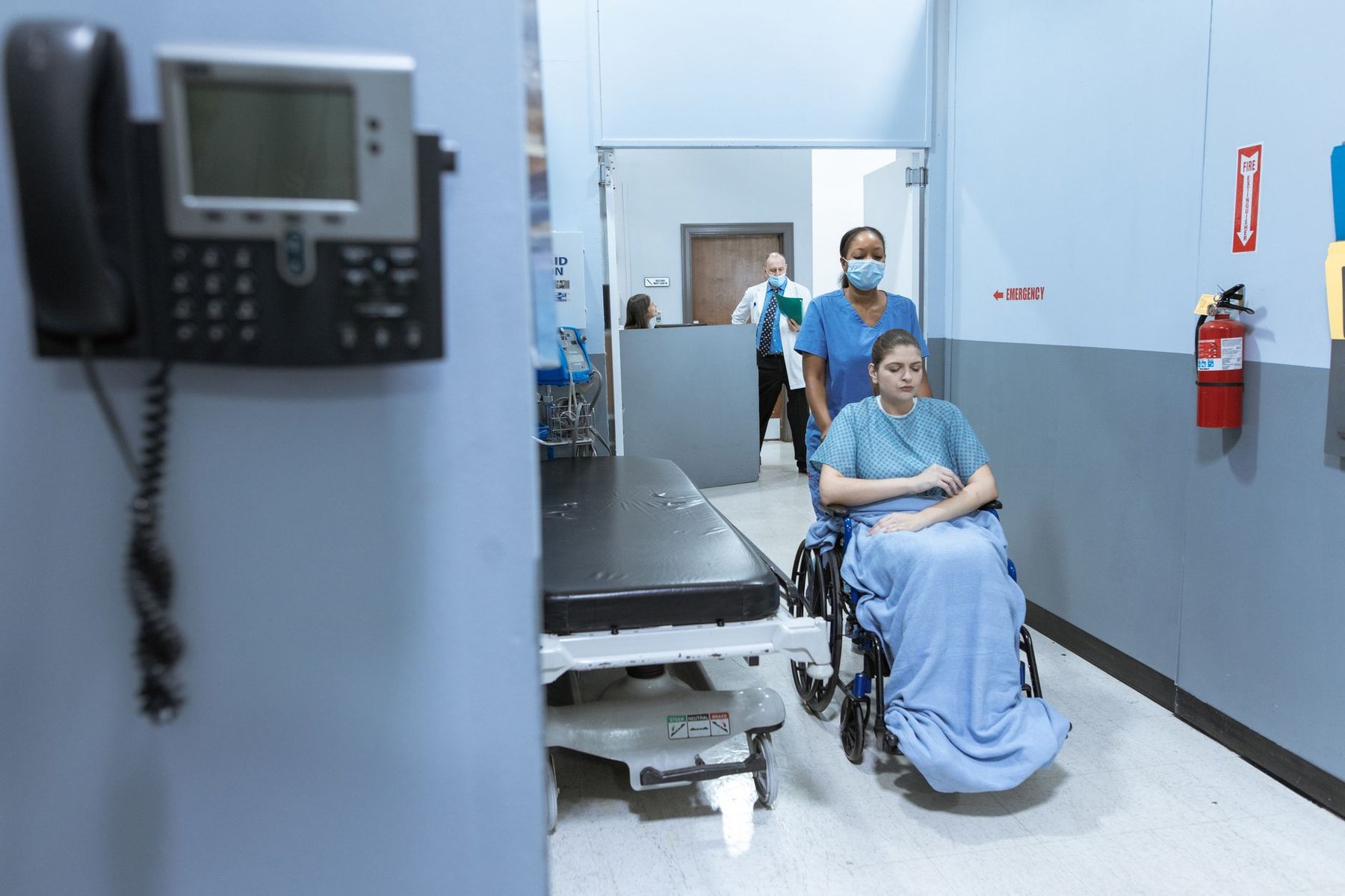
Who pays for hospital discharge supports comes down to one dividing line: Medicare and Queensland Health fund the hospital admission and medical treatment, while the NDIS funds only the disability-related supports a participant needs to leave hospital safely and stay safe at home. Get that boundary wrong, or leave it unclear, and discharge planning stalls, sometimes for months.
The Funding Boundary Between Health and Disability Support
Every hospital stay in Queensland is a health system responsibility from admission to the point a treating team says a patient is medically ready to leave. That includes surgery, medication, nursing care on the ward, and any rehabilitation delivered inside the hospital. None of it touches an NDIS plan.
The moment “medically ready” is declared, though, the funding conversation changes. The NDIS does not fund healthcare. It funds the disability-related supports a participant needs once they are back home: personal care, Supported Independent Living, home modifications, assistive technology, and the coordination needed to get all of that organised before the hospital bed is needed for someone else. The scheme is entirely publicly funded and is not means-tested, so eligible participants are not asked to contribute toward these discharge supports out of pocket (NDIS, 2026).
Private health insurance sits alongside this boundary rather than inside it. Cover can reduce or remove out-of-pocket costs for the hospital admission itself, such as a private room or choice of surgeon, but it does not extend to disability-related discharge supports. A privately insured patient who is not an NDIS participant and does not meet aged care criteria has no equivalent scheme to fall back on, and can face genuine out-of-pocket exposure for home modifications, equipment, or paid support at home unless family, informal carers, or a GP-coordinated community care plan can fill the gap.
This sounds tidy on paper. In practice, the handover between a hospital discharge team and an NDIA planner is where families lose weeks, sometimes months, if nobody is actively managing it.
The NDIA’s Hospital Discharge Pathway
The NDIA runs a dedicated hospital discharge pathway rather than leaving admitted participants to the standard planning queue. Once a hospital notifies the NDIA that a participant has been admitted, the agency commits to making contact within four business days, and assigns a Health Liaison Officer to work directly with hospital staff and specialist planners. The aim is a hospital discharge plan approved within 30 days of notification, following a 14-step process that runs from participant identification through to a formal handover to a support coordinator, a pathway agreed at the Disability Reform Ministerial Council in 2022 (NDIS, 2026).
Non-participants are not locked out of this either. If someone is admitted to hospital without an NDIS plan but has, or has recently acquired, a permanent and significant disability, hospital staff can refer them to the NDIA to start an access request, assessed as a priority rather than joining the general queue.
That pathway has produced real gains at points over the past two years. The NDIA reported that the national average time between a participant being declared medically ready and actually leaving hospital fell to 20 days in November 2024, the lowest monthly figure on record (NDIA, 2024). That number matters because every extra day in an acute bed is a day of hospital-funded care being used for a need the health system was never designed to solve, and a day a participant spends further from home and routine.
A discharge plan still has to satisfy the same NDIS funding criteria as any other plan. Hospitalisation does not lower the bar; it just compresses the timeline for meeting it.
Interim Supports While the Plan Catches Up
Few participants go from hospital bed to a fully resettled home in one step. The NDIA recognises this, which is why interim or “bridging” plans exist specifically for discharge. A short to medium term plan can include Support Coordination to organise providers, along with accommodation options while a permanent home is prepared or modified.
Support Coordination is usually the funding line doing the heaviest lifting during this window. It sits under the Capacity Building budget and covers coordinating providers, reviewing the plan against emerging needs, and making sure services are actually in place before a discharge date is locked in, rather than promised on paper. If a participant’s existing home is not yet safe or accessible, Short Term Accommodation can cover a temporary stay, and Medium Term Accommodation can bridge a longer gap, funded for up to 90 days and extended only in limited circumstances under current NDIS guidelines (NDIS, 2026).
Home modifications and assistive technology, things like grab rails, shower chairs, or a ramp, sit in a different category again. They are gated by an occupational therapist’s assessment first. No OT assessment, no funding decision. Families sometimes push for equipment before that assessment happens, hoping to speed things up. It rarely works, and it can add delay rather than remove it.
The table below sets out who pays for hospital discharge supports at each stage of a typical transition, so it is clear which system owns which cost.
| Stage or support type | Who pays | Funded under |
|---|---|---|
| Hospital treatment, surgery, ward-based nursing care | Medicare and Queensland Health | Public health system |
| Personal care and daily support after discharge | NDIS | Core supports |
| Support Coordination during transition | NDIS | Capacity Building |
| Home modifications and assistive technology | NDIS (after OT assessment) | Capital supports |
| Short-term or medium-term accommodation bridge | NDIS | Core supports (interim plan) |
| Short-term recovery care for people aged 65 and over | Commonwealth Government | Transition Care Programme |
A discharge plan that only exists on paper doesn’t get anyone out of a hospital bed. The funding line matters less than whether someone specific is accountable for making the calls that day.
When Aged Care Rules Apply Instead
Age changes which system pays, and this is the distinction most discharge guides skip entirely. For participants aged 65 and over, or already in the aged care system, the primary funder of short-term post-hospital recovery care is usually the Commonwealth’s Transition Care Programme, not the NDIS and not a Home Care Package. The Commonwealth pays providers a daily subsidy, and the client may also pay a daily fee.
The interaction with Home Care Packages catches families out. A person cannot start a new Home Care Package while actively receiving Transition Care. An existing package can be placed on hold instead, and its subsidy can keep running for up to 28 days per financial year per episode of Transition Care before dropping to 25 percent of the basic daily rate (Australian Government Department of Health, 2025). In Victoria, the daily client fee for home-based Transition Care is capped at 17.5 percent of the basic single age pension rate, which gives a sense of how the cost-sharing is meant to work (Victorian Department of Health, 2025). If you are navigating this overlap, a discharge planner or the aged care system’s own advisers are the right people to confirm which rules apply to a specific situation, not a general guide like this one.
The Reality on the Ground in Queensland and Beyond
Official pathways describe how discharge is meant to work. The lived numbers describe what actually happens when a system is under pressure, and Queensland’s own data tells a blunter story than the national averages suggest.
Around the same period, the Queensland Public Advocate estimated roughly 274 young people with disability and 320 older people were medically ready for discharge but still occupying hospital or health facility beds (Queensland Public Advocate, 2021). More recent reporting suggests the pressure has not eased: projections put the number of people stuck in Queensland hospital beds awaiting aged care or NDIS placement on track to reach 1,700 by 2027 (Mirage News, 2026).
Queensland is not an outlier. In New South Wales, the count of stranded patients rose from 871 to 1,276 between March 2025 and March 2026, with the NDIS-related subgroup climbing from 274 to 328 over the same period (NSW Government, 2026). Tasmania’s public hospitals carried an average of 26.4 patients between May and September 2023 who were medically ready for discharge but still waiting on NDIS access or supports (Tasmanian Department of Health, 2023), and as recently as mid-September 2026, reporting described three NDIS clients still stuck in a north-west Tasmanian hospital, a sign the bed-block problem is current, not historical (ABC News, 2026).
Nationally, reducing the number of NDIS patients languishing in hospital beyond their medically ready date was estimated to save the health system up to $550 million (Sydney Morning Herald, 2023), a figure that says as much about the scale of the waste as it does about the savings on offer.
The NDIS Quality and Safeguards Commission updated its practice guidance for providers on transitions of care between home and hospital in January 2025, a sign that regulators see this handover as a genuine risk point for participant safety, not just an administrative inconvenience (NDIS Quality and Safeguards Commission, 2025).
What Families Can Do During Discharge Planning
Working out who pays for hospital discharge supports is only useful once you know who is actually doing the work on each side of that line. Four roles typically sit around the table: the hospital’s discharge planner or social worker, an occupational therapist assessing the home environment, an NDIA planner or Health Liaison Officer, and a Support Coordinator managing the pieces in between. If a hospitalisation has changed a participant’s support needs, that is grounds for an urgent or unscheduled plan review, not a wait for the next scheduled reassessment date.
A few habits make the process move faster rather than slower:
- Ask the hospital discharge team, on day one of admission, whether the NDIA has been notified. Do not assume it has happened automatically.
- Request an OT home assessment early, even before a discharge date is confirmed, since equipment and modifications cannot be funded without one.
- Confirm in writing who is coordinating the transition. If no Support Coordinator has been assigned and the situation is complex, ask for one to be funded under the interim plan.
- If a discharge feels unsafe or premature, raise it directly with the hospital’s social work team, and consider contacting the Queensland Public Advocate’s office if concerns about capacity or decision-making are involved.
Where a Provider Like Ours Fits Into the Picture
Funding lines only matter if there is a competent team ready to deliver against them the day someone walks out of hospital. That is the part families rarely get told about in advance: an approved plan is not the same as a ready home. Advanced Disability Management works with adults with profound or complex disability across Cairns, Townsville, and Brisbane, often stepping in exactly at this transition point, whether that means Supported Independent Living, 1:1 high-intensity personal care such as PEG feeding, wound management, or seizure monitoring under registered nurse oversight, or working alongside a participant’s existing allied health team so a discharge plan reflects what daily life will actually require.
We were founded by parents who navigated complex, high-needs care for their own child with Sanfilippo Syndrome, so the anxiety of a discharge date approaching with no confidence in what happens next is not abstract to us. It shapes how our team, guided by a deeply held commitment to caring for families as our own, approach every handover from a hospital bed back into a person’s own life.
If a discharge is on the horizon, or you are trying to make sense of an interim plan, a Support Coordination role, or where aged care rules might apply instead of the NDIS, we are happy to talk it through. Call us on 0425 168 053, email [email protected], or reach out through our contact page, and let’s work out what the transition actually needs to look like for your family.
Can I choose which Support Coordinator manages my hospital discharge?
Yes. Support Coordination funding in an NDIS plan gives participants choice of provider, including during a hospital discharge. If a hospital social worker suggests a default provider, you are not obliged to accept it. Ask your Support Coordinator or Local Area Coordinator what your options are, and choose someone who already understands complex or high-intensity support needs if that applies to your situation.
What happens if my NDIS plan runs out while I am still in hospital?
Plans do not simply lapse mid-admission. If a review is due while a participant is hospitalised, the NDIA can extend the current plan or bring forward an urgent review, since hospitalisation itself is grounds for an unscheduled reassessment. Speak to your planner or Support Coordinator as early as possible so this is managed before discharge, rather than discovered at the last minute.
Does the NDIS pay for transport home from hospital?
Transport supports can be included in an NDIS plan where a participant’s disability-related needs require it, but this is assessed individually rather than automatically covering every discharge trip. Non-emergency patient transport arranged by the hospital may also apply in some cases. Confirm which option applies with the hospital discharge team and your Support Coordinator before assuming either will cover the cost.
What if my family disagrees with the hospital about whether it’s safe to discharge?
Raise the concern directly and in writing with the hospital’s social work or discharge team, and ask for it to be documented. If concerns involve decision-making capacity or guardianship, the Queensland Public Advocate’s office can provide guidance on process. These are matters for the relevant hospital team, advocate, or guardianship body to work through, not something a support provider can override.
Is there a cost to families for the NDIA’s hospital discharge planning process itself?
No. Assessment, planning, and the Health Liaison Officer contact that form part of the NDIA’s hospital discharge pathway are part of the scheme’s core function and are not charged to participants or families. Costs only arise once specific supports, such as Support Coordination hours or accommodation, are delivered and drawn down against the participant’s approved plan budget.